



Points of Interest
Here you will find a selection of interesting things to go and see and a bit of the history behind them. These won't be full reviews or for specific day/road trips (although can be if you really want), it's more for things to see if you happen to already be visiting although you'll still find some key access information for them included.

The Witches Well, Edinburgh, Scotland.
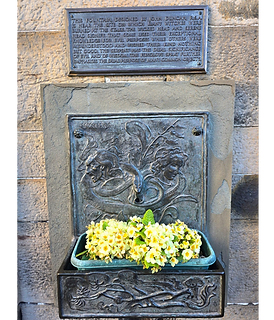
Whilst it looks like an ornate planter, the Witches' Well is actually a monument to the accused Witches burnt at the stake nearby between the 15th and 18th centuries. During this time, approximately 300 people (85% of whom were women) were tortured and executed as witches in Edinburgh on Castlehill. Approximately one in ten people accused of witchcraft in Scotland were sent for trial in Edinburgh, the rest were tried and executed locally. It is estimated that during this time period between 2500 and 4000 people were tortured, convicted or executed as witches in Scotland.
In reality, those accused were the marginalised members of society, the poor, widows, healers, midwives and those who were outspoken or spirited. They were the victims of state sanctioned panic and misogyny and religious obsession.
Commissioned in 1894 by Sir Patrick Geddes, was designed by John Duncan and depicts (in bronze) a snake curled around the heads of Hygeia, the Greek goddess of good health and her father Aesculapius, the god of medicine. Also featured is a foxglove, healing hands, trees and the evil eye. In recent times the well has become almost a place of pilgrimage for those wishing to pay their respects to the lives taken. You can find the well on Castle Hill. It is on the wall on right hand as you come to the top of the Royal Mile. The plaque is above the well itself and there is an information board on the fence next to it.
Access info:
🚽 The nearest accessible toilet can be found just inside of Edinburgh Castle, however, if you aren't going in the castle, then the nearest one and Changing Places Toilet can be found in the National Museum of Scotland.
🚗 There are a limited number of Blue Badge parking spaces (even more limited if there between May and October) available on the Castle Esplanade but these must be booked by phone or email.
🩼 The ground is made up of large smooth slabs. There are no benches available nearby.

In Edinburgh, on the wall on the corner of George IV bridge and the Lawnmarket is a plaque which reads, "Site of the last public execution in Edinburgh". The site of the gallows is marked by three brass plates set at the edge of the pavement in front of this notice. George Bryce, the Ratho murderer, was executed here on 21st June 1864 , the last public execution in Edinburgh." George Bryce was hanged for the murder of Jeanie Seaton but unfortunately the rope hadn't been measured correctly by the hangman Thomas Askern. This botched execution led to all future hangings in Edinburgh being done behind closed doors.
Whilst this spot is a stop on some of the fantastic guided tours, many will walk past without knowing what happened there.
Access info:
🚽 The nearest accessible toilet and Changing Places facility can be found in the National Museum of Scotland.
🚗 There are a limited number of Blue Badge parking spaces (even more limited if there between May and October) available on the Castle Esplanade but these must be booked by phone or email.
🩼 The pavement is made up of large smooth slabs, the road is cobbled. There are no benches available nearby.


The ducking stool at Leominster Priory is one of only two authentic surviving ducking stools in the UK (the other is located at the Collegiate Church of St Mary in Warwick). Despite what you might think, it wasn't used to test witches, in fact it was used to humiliate local shopkeepers, gossips and anyone who was seen to need 'social correction'. It was famously last used in 1809 on Jenny Peeps. She was a young woman found guilty of being a common scold (or public nuisance) for being derogatory about her husband in public. The magistrate chose to make an example of Jenny and she was paraded through the streets whilst secured on the stool down to the banks of the Kenwater river. This caused great excitement as the ducking stool hadn't been used in some time. The crowds jeered and mocked her and she was dunked twice in the cold water (in order to 'cool' down her temper). This didn't work of Jenny however, and when she was pulled out of the water she continued to hurl abuse at the magistrates representatives who were present. Her defiance caused the crowds to lose interest ending her punishment.
In 1817 the punishment was tried again on Sarah Leeke but because the water in the river was so low, they simply paraded her around the town.

Access info:
🚽 There is an accessible toilet in the church and the nearest verified changing places toilet is at the Tesco in Ludlow (10 miles away).
🚗 There is a public car park approximately 120m away from the entrance. The path to walk is on an incline. Bob managed with rests using his rollator.
🩼 The road is tarmacked, the path through the graveyard is made of smooth stone slabs. There is plenty of seating inside the church and around the graveyard.