

Speke Hall Part 1: Access Review.
- Annelise Pilkington
- Jul 9
- 7 min read

Updated: 6 days ago
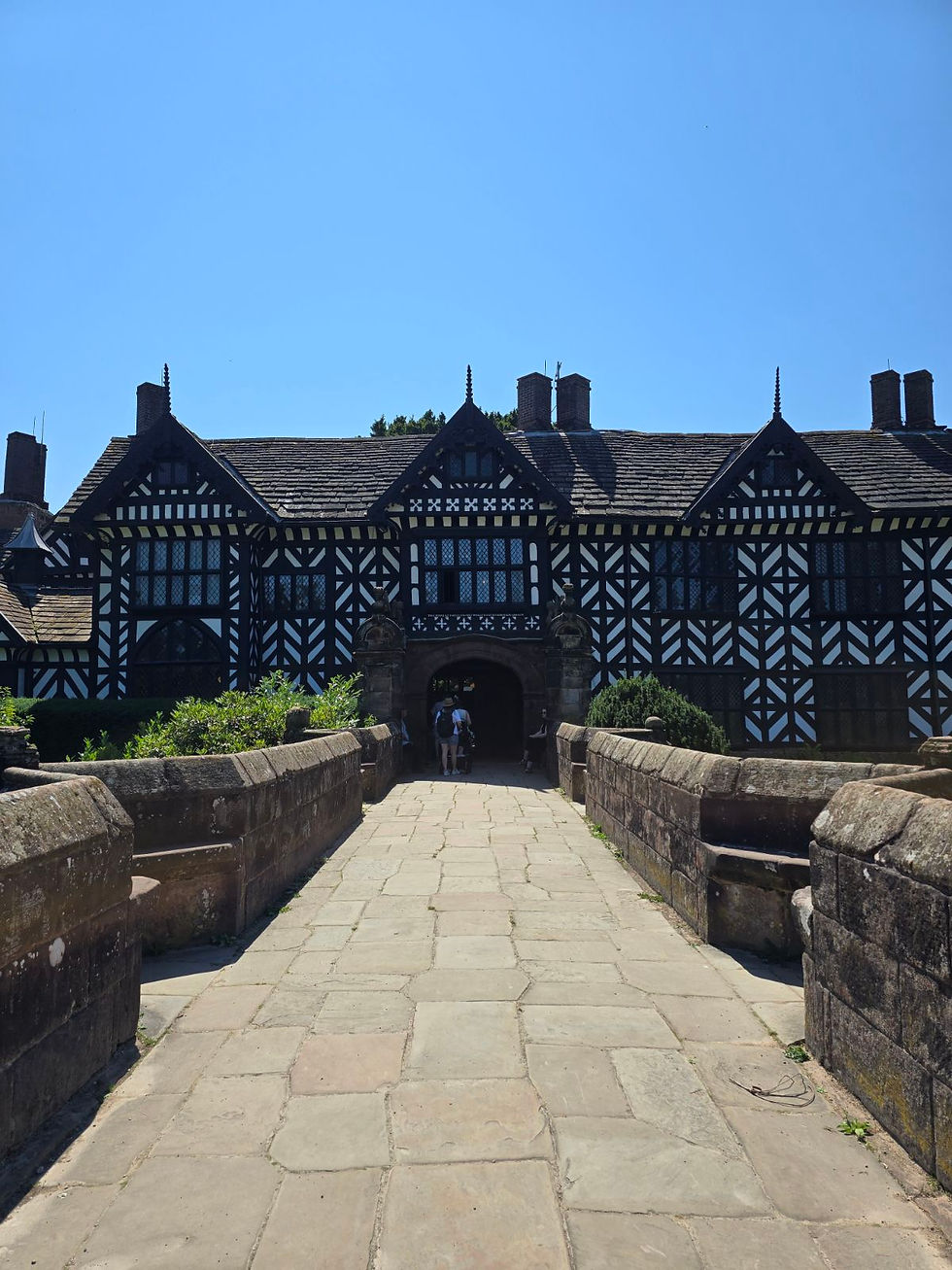
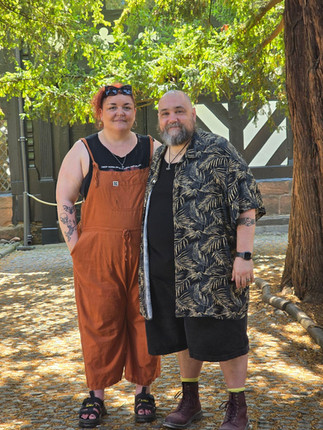
Despite only living down the road from it for most of my life, I had never visited Speke Hall and neither had Bob. After learning more about its ghosts, history and witch marks, we decided to take a quick trip while we were in South Liverpool (but we'll be back very soon to explore further). Run by the National Trust, Speke Hall is a grade 1 listed Tudor manor house. Built and owned by the Norris family, who were Roman Catholics, during the reformation, the Hall has a number of Tudor 'security systems' in place and a priest hole incase of unwanted visitors.
The whole house is reported to have witch marks near fireplaces, windows and entrances to protect those inside from negative entities. We managed to spot a few on our way round!
It is said to be one of the most haunted buildings in England with a Grey Lady who is believed to be Mary Norris, who in despair at her husband squandering the family fortune, is said to have thrown her baby from the Tapestry room window and then hanged herself. There are reports of a Cavalier, a friendly and playful ghost and the ominous figure said to reside in the Blue Room as well as the sounds of children all amongst the reported hauntings. The sound of footsteps and crying have been reported as well as visitors experiencing physical manifestations such as nausea and the feeling of oppression.
Sadly, we didn't see any ghosts or experience anything ourselves, maybe we should take one of the ghost tours in the future?
🎟️ Booking.
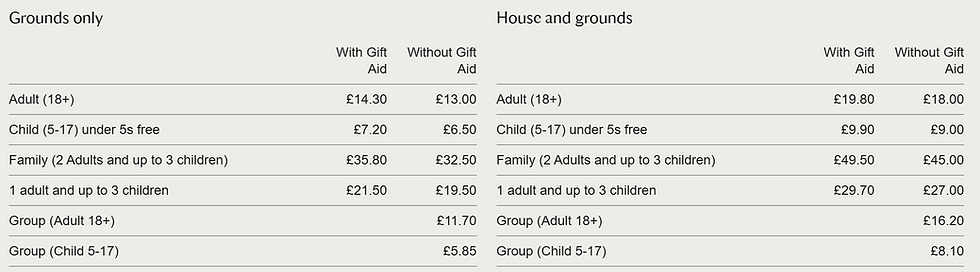
There is no pre-booking for tickets to visit Speke Hall, but it is recommended to pre-book some accessible facilities such as wheelchairs and mobility scooters etc. This can be done by phoning 01514277231. Visiting is free to National Trust members and the under 5's. Tickets can be bought for either just the grounds or for the Hall and the grounds. Companion tickets are available and can be 'bought' on the day of your visit, however it is worth mentioning that anyone can apply for a carer pass for the National Trust for up to two carer, whether they are members or not. These are available for free and last for up to 2 years. To apply for this either email enquiries@NationalTrust.org.uk or phone 0344 800 1895.
ℹ️ Accessibility Information Availability.
There is plenty of accessible information available but I have had to use three different websites to find it all including the National Trust site for Speke Hall, the Speke Hall access statement and AccessAble (difficult as the information is location based, not facility based). AccessAble has the most comprehensive information, but I don't find it to be very user friendly and often feel like it is aimed at businesses rather than the people using the businesses.
🚗 Parking.

There are 12 designated disabled parking bays near the main entrance to Speke Hall. However, if these are full it is possible to drop people off at the entrance and then park the car. There is ample standard parking on site. Parking is free of charge for all visitors. There are no EV chargers available. It is approximately 150m from the furthest disabled parking bays to the main entrance for the site. The ground is fine loose gravel.
🩼 Mobility.

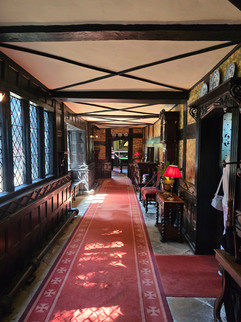
The car park used fine loose gravel as a base and the entrance is approximately 150m from the furthest disabled parking bay. There is a shuttle that, according to the website, will carry up to six passengers and is wheelchair accessible (when we were there, there was a golf buggy sized shuttle that would seat three and was not wheelchair accessible) to other places onsite such as the hall. We used this service, simply speak to a staff member and they will call for the shuttle. Our wait time was less than 2 minutes. This meant we were able to avoid a good 700m walk. Once at the hall there is a stone bridge to cross the enter the building. This was relatively smooth and easy for the rollator. Inside, the hall has thick carpet which Bob found easy to navigate with his rollator. Speke Hall is a Tudor manor house and as such isn't fully accessible. The ground floor of the site including the bookshop, toilets, cafes, gardens and the ground floor of the Hall are completely wheelchair accessible. The upstairs of the hall is not sadly. However, the site does off those who cannot manage the stairs use of a tablet that allows you to do a virtual tour of all of the rooms upstairs (including some hidden things according to the staff).

There are 4 manual wheelchairs and 2 mobility scooters available to borrow. It's recommended that visitors call 01514277231 to book these. Mobility scooters are not permitted inside the house.


With regards to the upper floor of the hall, there are a approximately 21 steps to navigate up. The steps are low in height and wide (I have size 9 feet and they fit comfortably on the step). There is a handrail on the left hand side of the staircase. The staircase is very wide with spaces to rest before continuing on (although there are no seats). Once upstairs, the hallway (roughly 60m long) is light and has several rooms off it. Each room would be big enough to accommodate a rollator if you could get it up the stairs, alternatively I would suggest asking for a chair if you need to rest as we were assured this would be possible. Prams and buggies are stored in the courtyard whilst visitors explore the house, I imagine rollators could be stored there too, although this area is uncovered and unmanned. To return to the ground floor there is a standard wooden staircase down (16 steps), however, it would be up to the individual to determine if the walk back along the hallway was worth the lower, wider steps.


The courtyard is laid to cobbles and is uneven. There was a chair available to rest on. The courtyard was shaded and cool thanks to two 500 year old Yew trees.
The book shop had level access and was easy to manoeuvre around with the rollator (and had a great selection of books!).
From the toilets and bookshop (where we picked up the shuttle) back to the main entrance is roughly 30m on fine, loose gravel.
🎧 Sensory.
There are a selection of sensory aids available to borrow at the main entrance with bags available to to carry them. Activity sheets are also available.


The site is very large and very quiet with lots of areas to rest and find some peace on busier days. Inside the hall, the rooms are light, but with the dark wood the hallways can seem a little dark.
🚽 Toilets.

There are two accessible toilets available, one near the entrance, the other in the Dairy Courtyard at the exit of the house. The toilet near the entrance does not require a RADAR key to access it.
There are no changing places facilities available on site, however there are several nearby including the Halewood One Stop Shop 1.4 miles away and South Liverpool NHS Treatment Centre 1.64 miles away.
☕️ Food and Drink.
There is a cafe and a tea room on site, the Home Farm restaurant and the Stable Tea Room both serve hot food, snacks, cakes and drinks. There are The tea room is only open during peak hours. Picnics are also welcome at Speke Hall and can be had on the lawns, or at the designated picnic areas with tables such as near the playground, and seating in various places around the site. There is also a covered area with seating, the Cart Shed, for shelter from the sun or when the weather is wet. Whilst we didn't see any refill points around the site, google says there are some so we will check this the next time we visit for part 2 and confirm. I have always found that the National Trust are always very happy to fill up water bottles at cafes on site.
🪑 Rest Opportunities.
There are opportunities to rest with benches across the site. We were also told that a chair can be provided if needed when touring the house.
🦻 Hearing Assistance.

There are assistive hearing systems in the main entrance, shop points and eating places, and portable induction loops available to borrow from the main entrance. There is also a tablet available to borrow to allow visitors with mobility challenges the opportunity to see what is upstairs via a video guide. The guide comes with BSL and subtitles. At every room there are cards with information about the area available for visitors to read, detailing the history and points of interest.
📖 Visual Support.
There are large print and Braille Guides available from the main entrance. Menus are available in large print in the restaurants.
🐕🦺 Assistance Dogs.
Assistance dogs are allowed on the grounds and inside the house with water bowls situated near the main entrance and near the Home Farm restaurant.
Our verdict.
For what we managed to see in a short space of time and for our needs, Speke Hall has to be one of the best sites for accessibility that we have visited. It really should be the blue print for staff training and facilities. Whilst we don't require the use of a changing places bathroom, the addition of this would be hugely beneficial for those that do need it.
That said, the staff were friendly, knowledgeable and helpful and the addition of the transport from the entrance to the Hall made all the difference to us. Without it, Bob would have struggled to make it to the hall (approximately 700m) , let alone enjoy and explore it. We are very much looking forward to returning for part 2 to explore other areas of the site and revisit some queries that we have.
💀💀💀💀💀







Comments